The Art of Playboy Online Copy of the Art of Playboy by Ray Bradbury
The Untold Truth Of Playboy
Getty Images
Playboy is one of the most iconic American publications of all fourth dimension, boasting a peak circulation of v.vi million copies in 1976. But the cosmos of founder and longtime editor-in-chief, Hugh Hefner, was much more than than just titillating nudie pics. Playboy has been a trailblazer of American counterculture. Here are some of the lesser-known facts surrounding Hefner'south pet project — skillful, bad, and ugly. This is the untold truth of Playboy.
Hefner sold his piece of furniture to fund the mag
Getty Images
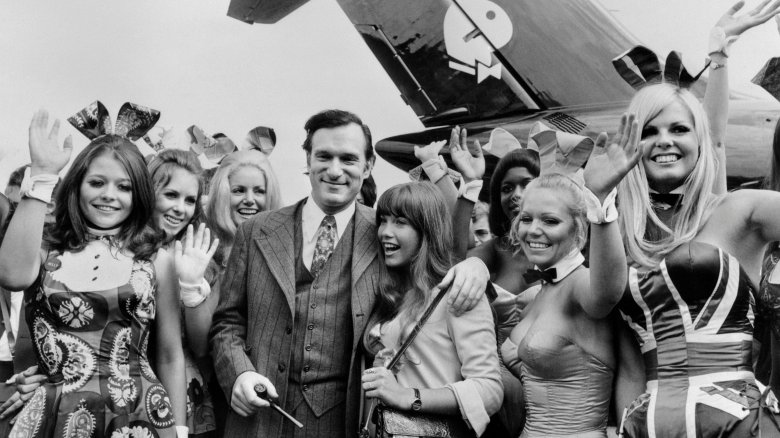
In December 1953, Hefner reportedly "mortgaged" the furniture from "what would be his offset wedding," according to The Chicago Tribune, for a $600 loan. He took that and some other money borrowed from those shut to him and used information technology to publish the first edition of Playboy, according to People.
In an interview with Time (via Australia's ABC News), Hefner spoke of the first result in relation to the country of America's sexual politics at the fourth dimension. "When I beginning published Playboy magazine and certainly when I grew up and when I was in college, having a baby out of wedlock was a scandal. A scandal that drove some people to suicide. Abortion was illegal, oral sex was a major felony. Even oral sex inside of a marriage was illegal, and very few people know that. Playboy played a major part in changing all those laws," Hefner said. Who would've guessed i of Hefner's proudest achievements would have been the de-stigmatization of married oral sex? Oh right, everyone.
Hefner wanted to call the mag 'Stag Political party'
Getty Images
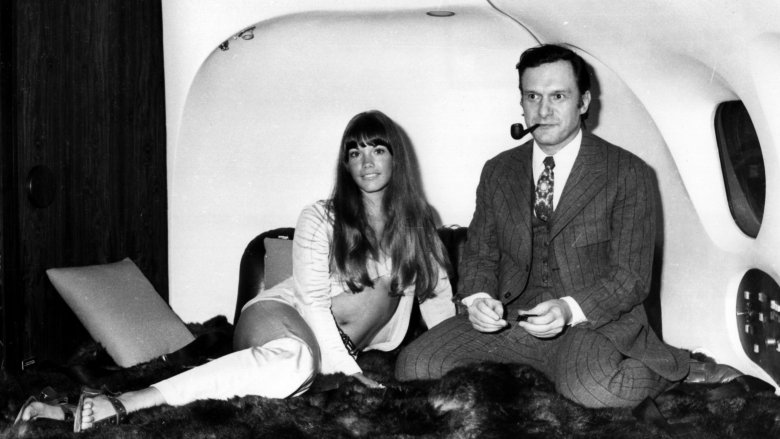
Considering office of Playboy'south mission statement declared the mag's intended readership was men who "bask mixing upwards cocktails and an hors d'oeuvre or 2, putting a petty mood music on the phonograph and inviting in a female person associate for a quiet discussion on Picasso, Nietzsche, jazz, sex," it'south kind of remarkable that Hefner's original title was Stag Political party. That hardly evokes an air of cosmopolitan elegance.
Luckily for Hefner, his longtime fine art managing director, Art Paul was with him from the very beginning. "Hef was very insistent that the mag be called Stag Party— I told him it was madness," Paul told IIT Magazine. A hunting magazine named Stag didn't like the idea, either. After brainstorming new "titles and animals that would represent a frisky slice of life," another founding associate, Eldon Sellers, pitched the championship, Playboy. The iconic bunny logo that would eventually come to correspond a merchandising juggernaut also came at this fourth dimension.
The iconic logo wasn't originally intended to correspond the brand
Getty Images
Art Paul also told IIT Magazine that the bunny logo took him "about one hr to sketch" and that they were simply going to use it "as a characteristic endpoint to articles, merely those plans changed." That understatement is echoed past every T-shirt, trinket, and sunburn tattoo emblazoned with the at present ubiquitous rabbit head. As for why they chose that item animal? "The word 'playboy' itself is not a serious one. The rabbit is not serious; information technology was basically a signal that we could brand fun of ourselves," Paul said.
Hefner described his ain absolutely quirkier reasons for the mascot choice in a 1976 interview excerpted by the book, Sexual practice in Linguistic communication. "The rabbit, the bunny, in America has a sexual meaning; and I chose it considering it's a fresh brute, shy, vivacious, jumping — sexy. First it smells you then it escapes, then it comes dorsum, and you feel like caressing information technology, playing with it. A girl resembles a bunny. Joyful, joking. ... The Playboy girl has no lace, no underwear, she is naked, well-washed with lather and water, and she is happy," Hefner said. Yep, that'south extremely weird. All of it. Moving on.
The magazine one time featured a sixteen-year-old centerfold
Getty Images
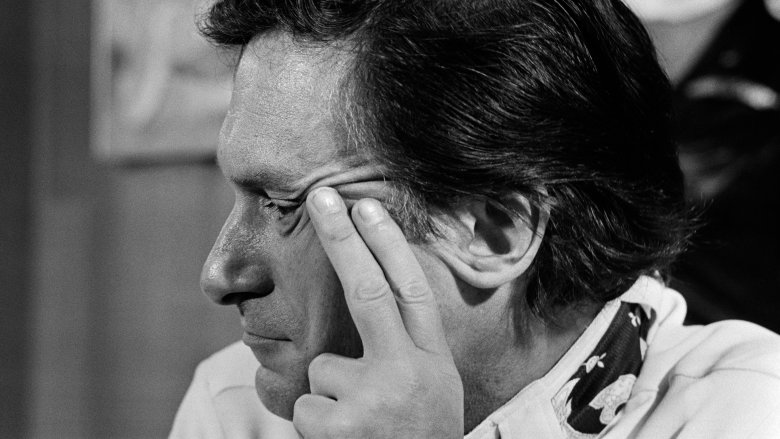
According to The New Yorker, Hefner establish himself in hot h2o early in his publishing career in 1958 when the magazine "published a centerfold of a 16-twelvemonth-old girl." Hefner faced charges of contributing to the malversation of a minor, but the case was dismissed afterwards he produced "written permission from her female parent," which at the time was apparently a good enough legal defense for taking semi-nude photos of a high-schooler.
The inherent grossness of the teenager's mother notwithstanding, Hefner did allegedly adapt the magazine's historic period policy to "never again publish a photograph of an unclothed woman under xviii." After that, he oft picked girls who onlylooked like they were minors,The New Yorker reported. Whew.
The determination to remove nudity from the magazine actually worked

In 2015, Playboy decided to remove nudity from the magazine, citing widely bachelor and gratis internet porn equally a key factor. "That battle has been fought and won," Playboy chief executive Scott Flemish region told The New York Times, calculation, "You're now ane click away from every sexual activity act imaginable for free. And so it'due south just passe at this juncture." The new, nipple-gratuitous editions of the mag lasted about a year earlier they reversed the conclusion.
Having as well undergone a shift in direction — Hefner'due south son Cooper stepped into the role of chief creative officeholder — the brand shifted back to its roots with a February 2017 tweet from Cooper that stated, "I'll exist the beginning to acknowledge that the manner in which the magazine portrayed nudity was dated, merely removing information technology entirely was a error. Nudity was never the trouble because nudity isn't a trouble. Today we're taking our identity dorsum and reclaiming who nosotros are."
That all sounds great, except the non-nude move was actually working. Co-ordinate to sales figures reported past the Alliance for Audited Media (via New York Mail), single-re-create sales increased "to 47,203 a month." A Playboy spokesman even reported an uptick of 100,000 new subscribers as of September 2016. So why change back?
Speaking with LA Weekly in July 2016, Cooper said, "People who are immature don't view nudity as a problem. I hateful, Vogue today has nudity. The problem was how Playboy presented the nudity." Got it, so Playboy is now chasing the elusive "youth audition" with their naked pictorials. Could that mean a tastefully unclad Pokémon hunt could be in the works?
The magazine has been a champion for costless speech
Getty Images
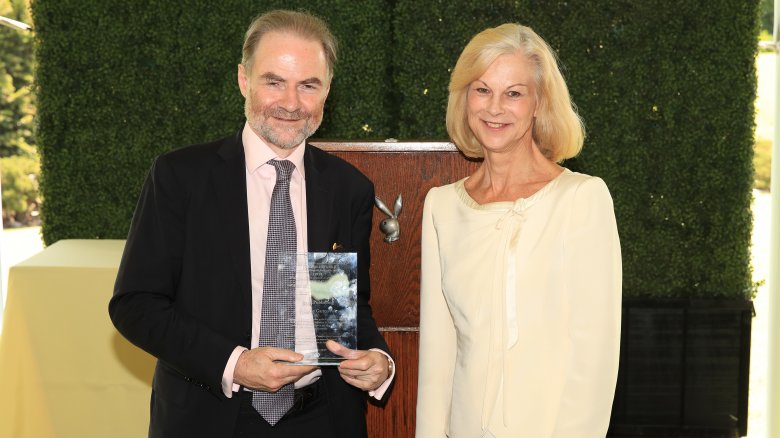
Though naked Playmates are ordinarily the first thing anyone thinks near in association with Playboy, the magazine and Hefner have been recognized as defenders of free oral communication. In 2010, Hefner was awarded the Offset Subpoena Laurels by Pen Heart USA, which describes the honor as beingness "given to a candidate who has done work in the domestic The states to protect the First Amendment." The distinction puts Hefner amidst other prestigious recipients like outspoken political critic Pecker Maher and investigative journalists Glenn Greenwald and Laura Poitras, who broke the Edward Snowden/NSA story.
Through the Hugh Hefner Foundation, Hefner'southward daughter, Christie, who served as a longtime caput of Playboy Enterprises, set upward the brand's own mode to recognize free oral communication pioneers by establishing their own Beginning Subpoena awards. According to Business Insider, since 1979, the foundation has awarded multiple recipients per year "whose actions support and often fight to preserve the values of the Kickoff Subpoena."
Major literary works were serialized in the magazine
Getty Images
The onetime joke about Playboy, of course, is "I buy it for the articles," and while the centerfolds have conspicuously supplied the drawing power for "readers," the magazine adult into something of a literary powerhouse throughout the '60s and '70s. There are almost too many heavy-hitting authors to mention who have contributed to Playboy, but according to the BBC, the listing includes John Steinbeck, Jack Kerouac, Arthur C. Clarke, Margaret Atwood, Haruki Murakami, and many more.
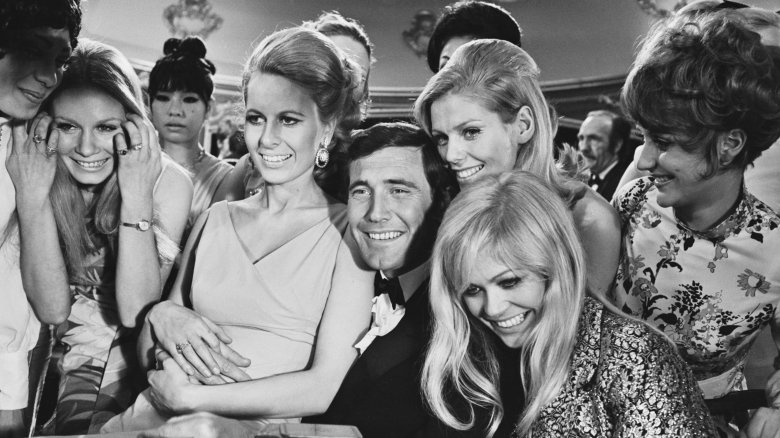
In fact, Ray Bradbury's classic, Fahrenheit 451 — remember that from your 7th grade summer reading listing? — was reportedly never exposed to a mass audience until Hefner "paid $400 for the rights to serialize information technology the following year." He did the aforementioned matter with a piddling novel called On Her Majesty'due south Surreptitious Service, you know, just ane of Ian Fleming'southward James Bond novels that was afterwards adjusted into a blockbuster film.
For these — and many more — contributions to the literary globe, Hefner was also given the Award of Honor from Pen Eye USA. Jamie Wolf, vice president of the organisation, told the BBC, "[Hefner] published Saul Bellow, he published Gabriel Garcia Marquez, he published John Updike, he published an boggling range of writers, serious literary writers who you were non otherwise getting when you went into the grocery shop. And he was paying them substantial wages. And some of them were blacklisted writers who other people wouldn't publish." And then, aye, information technology would seem someone was reading the articles.
China basically saved the company
Getty Images
Co-ordinate to The New York Times, a lot of the conclusion to remove nudity from the magazine reportedly came from Playboy'due south dependence on the Chinese marketplace's apparently voracious ambition for their merchandise, which at the time of their reporting amounted to "40 percent of that business." Combined with the fact that at the time, "the United States edition [of the mag] was losing nigh $3 million a year" and could only be "considered assisting if money from licensed editions around the world is taken into account," the success of the make'due south trade was mission critical. It'due south especially interesting, because the actual magazine is banned from the notoriously bourgeois mainland China — although bachelor in Hong Kong — and nonetheless, they can't seem to get enough of Playboy-branded paraphernalia.
Quartz backed the New York Times' findings with even more center-opening figures that betoken to just how reliant on the Chinese market place the unabridged Playboy enterprise truly is. From 2009 to 2013, the company'due south annual licensing revenues shot upward a whopping $28 million and represented approximately half of the company's overall revenues at the time. That ways that if Chinese consumers make up one's mind to be nonplussed with the reintroduction of naughty bits in the magazine, they could collapse the whole company with their purchasing power. Um, has anyone told Cooper?
There's a subconscious bunny on every cover
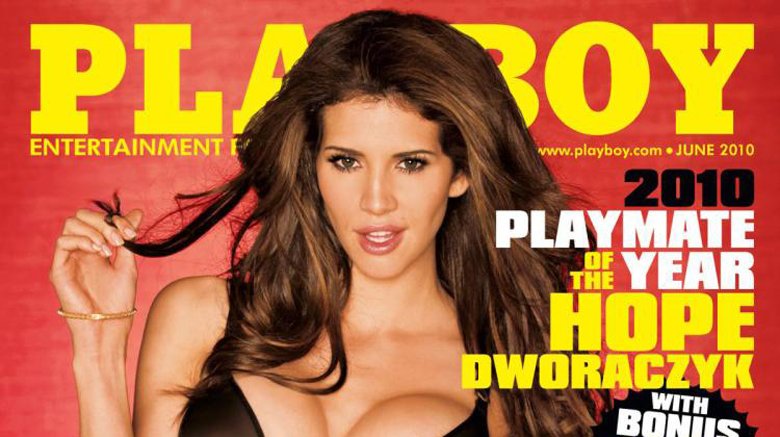
Since the second upshot of the mag, when Art Paul'due south now-infamous bunny logo was debuted, Playboy has ensured that the iconic logo has appeared in some shape or form. It's said that hiding the logo started as a joke, merely it's now something the publication has stuck with for decades. Don't believe u.s.a.? Wait until yous leave work, or at to the lowest degree burn up incognito mode, and do a bones Google search for "Playboy cover." While you're at it, see if y'all can spot the one nosotros picked up there. (Hint: Eyes up top, you scamp.)
The magazine was an influencer in the architecture and blueprint space
Getty Images
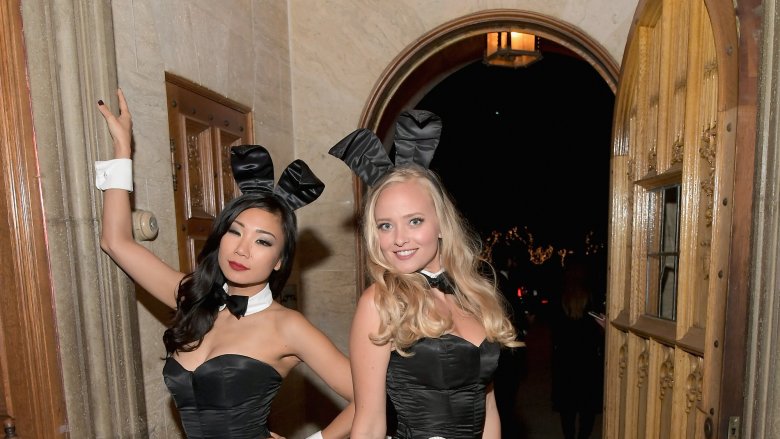
Because Hefner's aforementioned "Picasso, Nietzsche, jazz" hipster-earlier-hipsters-were-a-matter aesthetic, it'due south no surprise that over the years he spent almost less fourth dimension focusing on the centerfolds, and more than time focusing on the architectural implications of the chairs they aptitude over. At least, that's according to historian Beatriz Colomina, who headed a Princeton study examining the Playboy founder's obsession with design.
Speaking with Architecture Magazine, Colomina said that from the very beginning, and because of the magazine'southward Chicago roots, it represented "avant-garde architects" like Frank Lloyd Wright, Mies Van Der Rohe, and "the whole generation of the 1950s: Nelson, Eames, Saarinen, all of them." Colomina even went as far as saying, "Playboy did more for mod architecture and pattern than any architectural journal or fifty-fifty the Museum of Modern Art."
But don't misunderstand, Hefner's motivations ever led dorsum to his primary focus. "They actually felt that this was an important tool — actually crucial — for seduction," Colomina said, adding, "The modern apartment is a necessity for the bachelor, who has to surround himself with all these gadgets and all this mod furniture, and eventually fifty-fifty the architecture, the Playboy Pad. These are the settings in which seduction [happens]." Romance through feng shui. Genius.
Hefner used the magazine to advocate for ceremonious rights
Getty Images
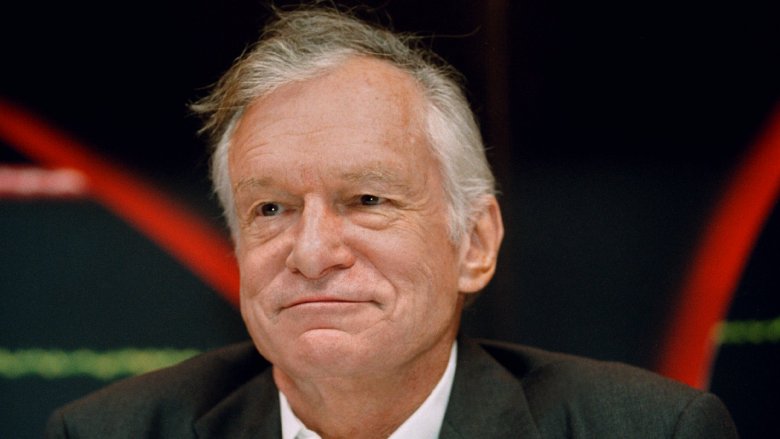
Through the years,Playboy was a flashpoint for many cultural happenings, including gratis speech advocacy, literary enlightenment, and cutting-edge design appreciation. Civil rights can also easily be added to that list.
In an interview with CBS Los Angeles, Hefner said, "I felt from a very early age that there were things in society that were incorrect, and that I might play some small role in irresolute them." He then went on to list exactly how he tried to practise that, including the desegregation efforts at his Playboy Clubs that even involved him buying back franchises from owners who refused minority members and performers at the front door. He also said that he sought out relationships with Rev. Jesse Jackson and Martin Luther Rex Jr. — the mag just so happened to impress the "last published slice written" by King before his death — and was instrumental in "the funding of Push button and the Rainbow Coalition." Just expect, at that place'due south more.
Hefner likewise gave a platform to Miles Davis in the first-ever Playboy interview during which the jazz legend "didn't talk then much nearly music, he talked near wishes and equality." According to People, Hefner besides strongly advocated for gay rights, women's reproductive rights, and religious freedom. In brusk, this was a man who was about living free, and he used every platform available to him to button that agenda.
It probably doesn't outweigh the fact that he exploited an underage girl and published enough of jailbait, but nothing is black and white.
Source: https://www.grunge.com/88352/untold-truth-playboy/
0 Response to "The Art of Playboy Online Copy of the Art of Playboy by Ray Bradbury"
Enviar um comentário